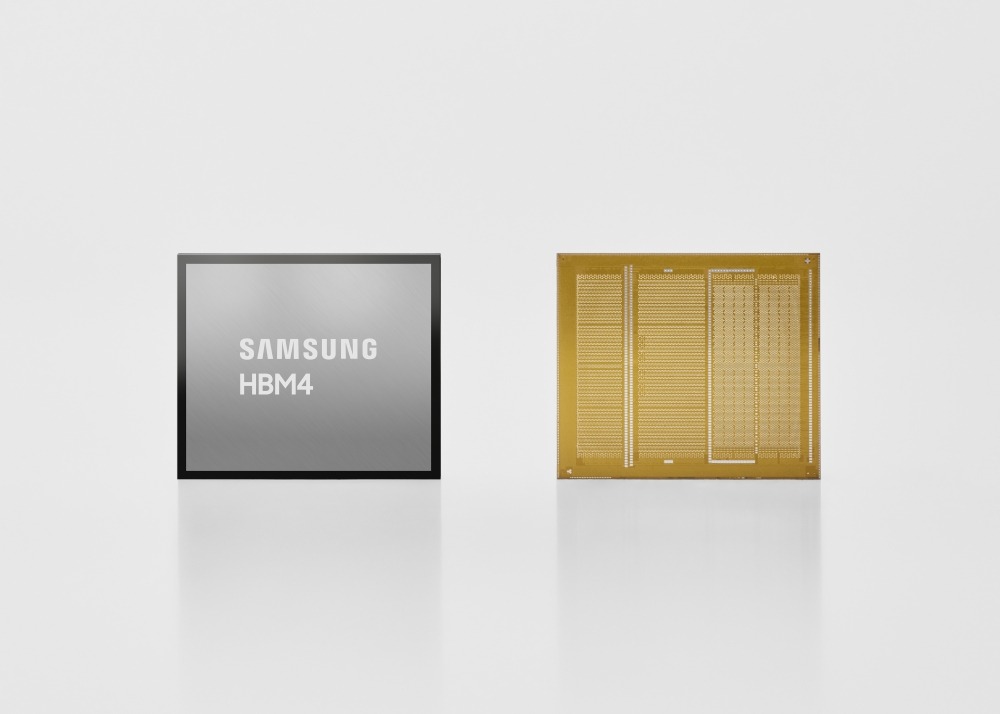
Samsung Electronics, a global leader in advanced memory technology, has achieved a groundbreaking milestone with the mass production of its highly anticipated HBM4 (High Bandwidth Memory 4), now being shipped to customers. This achievement positions Samsung at the forefront of the HBM4 market, marking a significant leap in the performance, efficiency, and scalability of memory solutions for the next-generation computing landscape, especially in AI-driven environments and data centers.
Samsung’s Breakthrough in HBM4 Technology
With the introduction of HBM4, Samsung has once again redefined the limits of memory bandwidth and processing speed. The company’s decision to adopt cutting-edge 6th-generation DRAM and 4nm logic process technology for the production of HBM4 has been pivotal in this achievement. By utilizing the most advanced 1c DRAM process and leveraging its optimized design techniques, Samsung has not only ensured stable yields but also achieved industry-leading performance without requiring any redesigns during mass production.
Sang Joon Hwang, Executive Vice President and Head of Memory Development at Samsung, highlighted the importance of this decision, stating, “Instead of sticking with the conventional methods of using existing designs, we took a bold step forward by implementing the most advanced nodes, such as the 1c DRAM and the 4nm logic process for HBM4. This allowed us to unlock significant performance potential, enabling us to meet the growing demands for higher performance from our customers.”
Enhanced Performance for AI and Next-Gen Datacenters
Samsung’s HBM4 has been designed with maximum performance and energy efficiency in mind, particularly in the context of rapidly expanding AI workloads and the need for high-capacity memory in datacenters. The memory module delivers a consistent transfer speed of 11.7 gigabits per second (Gbps), which is 46% faster than the industry’s standard of 8Gbps and significantly surpasses the previous generation’s 9.6Gbps limit. Samsung has also ensured that HBM4’s transfer speed can be boosted to 13Gbps, providing enhanced data throughput to address the growing bottlenecks associated with AI model scaling.
Moreover, the total memory bandwidth for a single HBM4 stack has been increased by 2.7 times compared to its predecessor, HBM3E, reaching a maximum of 3.3 terabytes per second (TB/s). This makes HBM4 an essential component for high-performance computing environments, where large datasets need to be processed at unprecedented speeds, particularly for AI-driven applications such as machine learning and deep learning.
Samsung’s HBM4 incorporates 12-layer stacking technology and is available in capacities ranging from 24GB to 36GB. Additionally, the company is preparing to scale up its offerings by utilizing 16-layer stacking to extend the available memory capacity up to 48GB, ensuring that it can meet the demands of future applications.
Energy Efficiency and Thermal Management
As the demand for higher memory bandwidth intensifies, managing power consumption and thermal performance becomes increasingly crucial. Samsung has integrated advanced low-power design solutions into HBM4’s core die to ensure that these challenges are addressed effectively. By leveraging low-voltage through silicon via (TSV) technology and optimizing the power distribution network (PDN), Samsung has achieved a 40% improvement in power efficiency. Additionally, thermal resistance has been enhanced by 10%, and heat dissipation has improved by 30%, compared to the previous generation of HBM3E.
These advancements make HBM4 an ideal solution for energy-conscious data centers and GPU-intensive workloads, where maximizing performance while minimizing power consumption is key to controlling total cost of ownership (TCO). This capability will be especially valuable in AI applications, where high-speed memory is essential to maintain system performance and energy efficiency during demanding computations.
Manufacturing Excellence and Robust Supply Chain
Samsung’s commitment to advancing its HBM roadmap is supported by its extensive manufacturing resources, which include some of the largest DRAM production capacities and dedicated infrastructures in the industry. With an integrated Design Technology Co-Optimization (DTCO) between its Foundry and Memory Businesses, Samsung ensures the highest standards of quality and yield during production, enabling faster time-to-market and more efficient production cycles.
The company’s ability to scale its production of HBM4 is supported by its resilient supply chain and strategic partnerships with key global players in the AI and datacenter sectors. Samsung’s deep expertise in advanced packaging technologies further streamlines its production processes, helping to meet the increasing demand for HBM4 in next-generation computing environments.
Samsung has already expanded its HBM4 production capacity significantly and expects to see a substantial increase in its HBM sales in 2026. The company’s proactive strategy in expanding its production capabilities will ensure that it is well-positioned to meet the growing demand for high-performance memory solutions in AI and computing.
Strategic Partnerships and Future Developments
Samsung is also focused on expanding its technical partnerships with major global GPU manufacturers and hyperscalers to support the development of next-generation ASICs (application-specific integrated circuits). These collaborations are vital for ensuring that HBM4 remains at the forefront of memory technology and can be seamlessly integrated into future systems that demand high-speed memory for complex AI models.
Looking forward, Samsung plans to introduce its next iteration of HBM technology, HBM4E, which will be sampled to customers in the second half of 2026. Additionally, custom HBM versions tailored to specific customer specifications will begin reaching the market in 2027, further cementing Samsung’s leadership in the high-performance memory space.
Conclusion
Samsung’s HBM4 is setting a new benchmark for high-performance memory in AI and datacenter applications. With its unprecedented processing speed, enhanced bandwidth, and improved power efficiency, HBM4 is positioned to play a crucial role in the future of AI-driven computing. As the demand for faster and more energy-efficient memory continues to grow, Samsung’s innovative approach to memory technology ensures that it will remain at the forefront of the next generation of computing. With its commitment to expanding production capacity and forming strategic partnerships with key industry players, Samsung is well-equipped to meet the challenges of an increasingly data-intensive world.